
Budgeting for the Next Difficulty Adjustment
Every payout in mining is divided by network difficulty, so the adjustment every 2,016 blocks is the closest thing the industry has to a scheduled price change. The estimate for the next one was −2.12% on 21 Sept 2026, which would lift a 114 TH/s credit from $4.33 to about $4.42 a day. Planning for a range around that figure is more useful than betting on the exact number.
Key takeaways
- At 114 TH/s, a −2.12% adjustment adds roughly $0.09 a day, while a +5% change removes about $0.20.
- Difficulty of 132.76 T and network hashrate near 1,003 EH/s were the inputs behind these figures.
- PPS+ settles hourly against current difficulty, so an adjustment shows up in the next credit rather than at month end.
- Model at least three cases — the estimate, flat and a rise — before committing to a hardware payment plan.
The denominator nobody watches
Ask a new miner what determines daily income and the answer is usually hashrate and coin price. Both matter, and both are the wrong place to look for surprises. The third variable, difficulty, moves on a published schedule and quietly rescales every machine on the network at once. A miner whose credit falls by 3% while the coin price is flat has usually met a difficulty adjustment, not a hardware fault.
This is why the daily figure from any calculator should be read with a date attached. It is a snapshot of a ratio: your hashrate over the network's, multiplied by the day's issuance. Change the denominator and the same machine earns differently without a single part being touched.
An estimate is a direction, not a promise
The −2.12% figure comes from the pace of block discovery during the current period. Blocks arriving faster than the target of ten minutes push difficulty up at the next adjustment; slower blocks pull it down. Because the estimate is recalculated as the period unfolds, it can drift substantially in the final days and occasionally change sign.
Treat it as a weather forecast: useful for deciding whether to carry an umbrella, useless for arguing about next month's rainfall. A miner who plans a hardware purchase on the assumption of a 2% cut is making a small bet with a large position, which is the wrong ratio.
Two percent in actual dollars
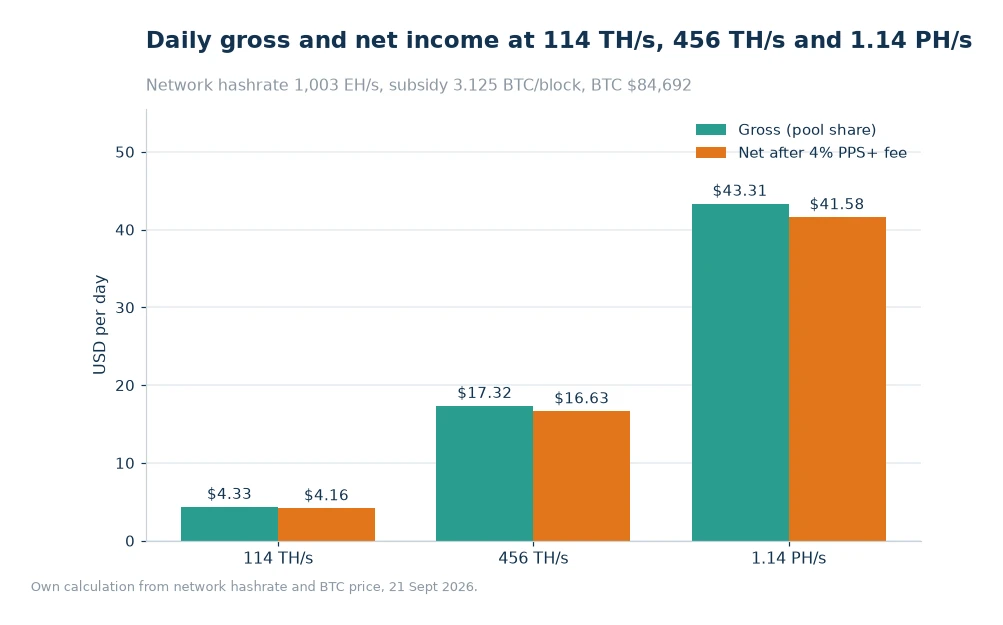
At 114 TH/s the credit is 0.0000511485 BTC a day, $4.33 at $84,692, or $4.16 after the listed 4% on the block-reward component. A 2.12% easier difficulty raises the coin amount by 1 ÷ 0.9788, or 2.166%, to about $4.42 gross. A 5% harder difficulty cuts it to $4.13 gross. The whole band from a favorable adjustment to an unfavorable one is roughly 29 cents a day at this size.
That is small enough to ignore for a week and large enough to matter for a year: 29 cents a day is $105.85 across twelve months. It is also smaller than the spread between a good and a mediocre electricity tariff, which is the comparison that should settle any argument about whether to chase difficulty timing.
Reading the period as it runs
Three numbers are worth glancing at each week: the current difficulty, the network hashrate and the pool's own share. Running on ViaBTC Mining Pool puts all three on one public page. The statistics page carries the first two alongside miner counts, and comparing them over several weeks shows whether the network is adding capacity faster than your own. If it is, your slice is shrinking even while your machine runs perfectly.
Watch for the shape rather than the level. A network that gains 8% in a month is a different planning environment from one that gains 0.5%, and the difference shows up in the number of months a machine needs to repay its purchase price. Record the readings in a note; memory is unreliable over a quarter.
Holding a margin for the swing
A budget that breaks when difficulty rises 5% was never a budget, it was a hope. Keep the assumed break-even point a few percent below the actual power cost so an adjustment in either direction does not force a decision in a hurry. The reserve can be small in absolute terms at 114 TH/s and still do its job, because its purpose is to buy time rather than to fund a loss.
Operators with several machines should apply the same logic per unit rather than to the total. An average that looks healthy can hide one machine that is already underwater, and difficulty adjustments widen that gap rather than closing it.
What an adjustment does to break-even
Break-even is a comparison between two daily numbers: what the pool credits and what the machine consumes. Difficulty moves only the first, and it moves it in the same direction for every unit on the network. A farm that was covering power at a 10% margin before a 5% tightening is still covering it afterwards, with a thinner cushion. A farm that was already at zero is now below it, and no operational improvement in the world changes the fact that the ratio moved.
That is the reason to track break-even as a percentage rather than a dollar figure. Percentages survive hashrate changes and difficulty changes alike, while dollar figures need re-deriving every time the network moves. One number, checked monthly, tells an operator whether the fleet is gaining headroom or losing it, and the adjustment calendar explains most of the movement without any further investigation.
Four difficulty cases at one hashrate
The table holds the machine constant and varies only the network denominator. Each row recomputes the daily credit from the same 450 BTC issuance, and the last column compares it with today's figure.
| Difficulty change | Daily BTC | Daily USD | Versus today |
|---|---|---|---|
| −2.12% (estimate) | 0.00005225 | $4.42 | +$0.09 |
| No change | 0.00005115 | $4.33 | — |
| +2% | 0.00005015 | $4.25 | −$0.08 |
| +5% | 0.00004871 | $4.13 | −$0.20 |
Worked example
Recompute the 114 TH/s credit under the estimate and under a 5% rise.
- Per terahash, the network pays 450 ÷ 1,003,000,000 = 0.00000044865 BTC daily.
- 114 TH/s: 114 × 0.00000044865 = 0.0000511461 BTC a day.
- Gross dollars: 0.0000511461 × 84,692 = $4.3317, rounded to $4.33.
- After the listed 4%: 4.3317 × 0.96 = $4.1584, rounded to $4.16.
- Easier difficulty at −2.12%: 0.0000511461 ÷ 0.9788 = 0.0000522538 BTC, or $4.4254.
- Harder difficulty at +5%: 0.0000511461 ÷ 1.05 = 0.0000487106 BTC, or $4.1254.
- Band between the two: 4.4254 − 4.1254 = $0.30 a day at this hashrate.
- 456 TH/s scales the same band to $1.20 a day; 1.14 PH/s to $3.00 a day.
Frequently asked questions
How often does Bitcoin difficulty change?
Every 2,016 blocks, which works out to roughly two weeks at ten-minute block times. The next adjustment was estimated at −2.12% when the data for this article was read.
Does a difficulty drop increase my payout immediately?
Yes under PPS+, which settles hourly against current difficulty, so the first credit after the adjustment reflects the new value. PPLNS settles after six confirmations on a block, so its timing differs.
Should a hardware purchase wait for an easier difficulty?
No. A 2% swing is worth about nine cents a day at 114 TH/s, far less than the cost of delaying a machine that could already be running.
Write the range into the plan
Pick a low, middle and high case for the network denominator, run each through the Profit Calculator, and check that the middle case still covers power plus a margin. If only the favorable case works, the plan is a forecast with a machine attached. Keep the three cases in the same note as the power tariff, so the next review has a baseline rather than a memory. The pool's own statistics sit alongside the calculator, which is enough to keep the range current without a spreadsheet subscription.
Difficulty stood at 132.76 T and network hashrate at 1,003 EH/s on 21 Sept 2026, with a 3.125 BTC subsidy and the coin at $84,692[1]; the −2.12% estimate came from mempool.space that day. Published 24 Oct 2026. Scenario values are arithmetic on those inputs.