
How to Read a Panel Specification Sheet Without a Mill Visit
A specification sheet is the only part of a factory you can audit from a desk, and it tells you more than a video of a production line, because it commits the mill to numbers. The skill is knowing which lines carry weight and which are decoration. On the film faced range Dongstar Group publishes sizes, six thickness steps, a ±0.5 mm tolerance and five face films from its pages in Linyi city — enough to build a real comparison between two suppliers.

Key takeaways
- Read the sheet in order of risk: size, thickness and tolerance first, core and grade second, surface film third, certification last.
- A tolerance statement is the difference between a mill that measures and a mill that estimates; ±0.5 mm is a published figure on the film faced range.
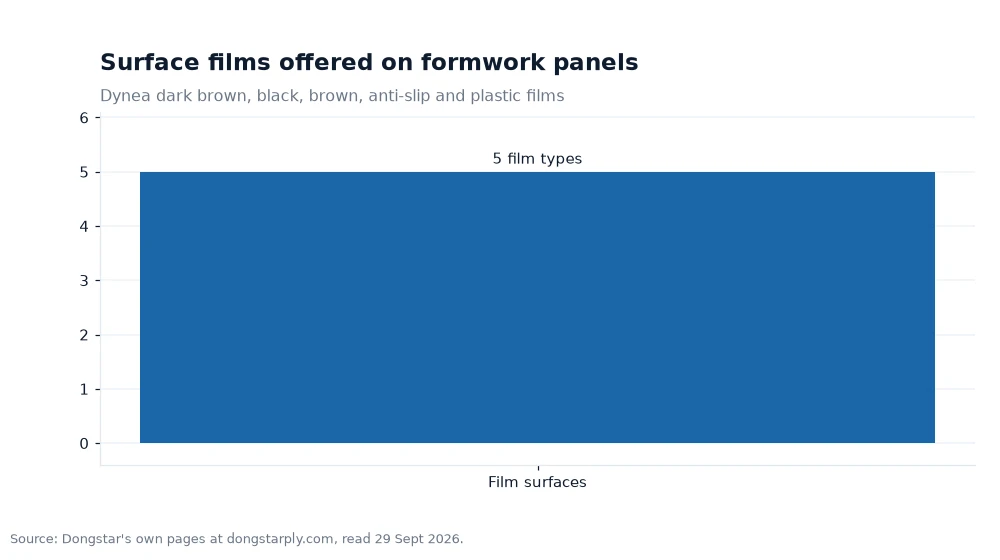
- Five face films are listed — Dynea dark brown film — black film, brown film, Anti Slip film as standard and plastic film on the product page — and each one answers a different site problem.
- Strike out any adjective that cannot be measured. "Premium" cannot be inspected; a thickness step and a core species can.
Begin with the fields that carry risk
Every panel datasheet contains the same handful of fields. The question is which ones a claim could ever be built on. Sheet size decides cutting yield and how a pallet loads. Thickness decides stiffness and how many pours a formwork panel survives. Tolerance decides whether the sheets sit flush in a clamp. Get those three into writing and half the risk has been transferred out of the conversation.
The published film faced sheet runs 1220 × 2440 mm, 900 × 2100 mm and 1250 × 2500 mm, or on request, in the six steps of 9, 12, 15, 18, 21 and 24 mm, with a ±0.5 mm tolerance. Compare that with a datasheet that lists a single size and calls the thickness "standard" — one of these documents can be checked on arrival, and the other cannot.
Read the tolerance line literally
Tolerance is the field buyers skip and inspectors test first. A ±0.5 mm band on a 1,220 mm sheet sounds generous until it is multiplied across a load. On a 500-sheet order it represents up to 250 mm of stacked height between a mill running at the tight end and one running at the loose end (example), which is the difference between a pallet that straps square and one that needs repacking.
It also affects the fit of anything the panel touches. If a site is assembling a formwork system with fixed clamps, sheets that sit at the thick end of the band will resist closing, and sheets at the thin end will need packing. That is why the tolerance statement deserves the same scrutiny as the thickness list, and why "close to nominal" is not an answer.
Then read the surface, film by film
Five face options are published on the film faced range, and they are not interchangeable labels. Dynea dark brown film is the specification most formwork buyers recognise; black film is described for its contrast and even surface, with resistance to water, chemicals and abrasion; brown film is positioned as the durable, cost-effective choice for construction work; plastic film covers general uses; and anti-slip film is named specifically for workshops and ramps where vehicles must not slide.
| Field on the sheet | Published value | The problem it solves on site |
|---|---|---|
| Dynea dark brown film | Listed face option | Familiar formwork surface with a recognisable brand of film |
| Black film | Listed face option | High contrast, even surface, water and chemical resistance |
| Brown film | Listed face option | Durable construction surface at a lower film cost |
| Anti-slip film | Listed face option | Grip for vehicles and operatives on ramps and decking |
| Plastic film | Listed face option | General protection where a branded film is not required |
The same logic applies to the substrate. Cores are published as poplar, eucalyptus, combi and birch; poplar is described as light, straight-grained and easy to machine, eucalyptus as stronger and moisture-resistant with good load-bearing behaviour, and birch as a dense hardwood option. A datasheet that names the species lets a buyer match the panel to its job instead of guessing.
Grades and glues: the invisible half of the sheet
Grades on the film faced range are listed as one-time hot press, two-time hot press and finger-joint, with finger-joint panels quoted separately at 8, 10, 12, 15 plus 18 mm. Finger-joint cores as standard are built from shorter lengths of timber joined end to end, which is why they are described as resistant to warping and cracking and are aimed at structural uses such as construction, flooring and furniture.
Glue systems are printed too: WBP melamine for water and weather resistance in outdoor, marine and formwork settings, and WBP phenolic for water, heat and chemical resistance in both interior and exterior work. Waterproof edge sealing is mentioned alongside them as a way to extend panel life. These lines rarely appear in a quotation, which is exactly why they are worth reading before one is written.
Words to strike out before you compare
Three kinds of statement survive on datasheets but not in an inspection. Unmeasurable adjectives — premium, superior, top quality — describe nothing that can be checked on arrival. Open-ended ranges — "any thickness available" — push the specification decision back to the buyer without a published default. And certification claims in the footer, without a product scope attached, tell you what the company holds rather than what the board you are buying holds.
Replace all three with the published set: sheet formats, six thickness steps, ±0.5 mm, four core species, three grades, five face films, and the ISO, CE, CARB and FSC documentation set. That list is short enough to fit an email, and precise enough that a Plywood Supplier can answer it line by line in one reply.
Worked example: how much surface one sheet actually presents
A buyer needs to know how much filmed area a delivery covers, because both faces of a panel are finished and both can be damaged. One 1220 × 2440 mm sheet presents 1.22 m × 2.44 m = 2.98 m² per face (example). With two faces: 2.98 × 2 = 5.95 m² of finished surface per sheet (example).
Scale it to 200 sheets and the delivery carries 200 × 5.95 = 1,190 m² of filmed surface to protect in transit, storage and service (example). That number is what makes the edge-sealing and packing statements on a datasheet worth reading: at that scale, a few damaged board edges per pallet becomes a measurable loss long before it becomes a visible one.
Frequently asked questions
Which line on a panel datasheet matters most?
Thickness combined with tolerance. Thickness sets the structural behaviour and the tolerance decides whether a delivery fits the system it was bought for, so the two are only useful together.
Can I verify a face film type from a photograph?
Not reliably. Film type is published by name, and the practical check on arrival is to compare the delivered face against the ordered description and the sample, not against a catalogue image.
What should I do with a datasheet that gives a range like "8 to 25 mm"?
Ask for the published steps. The film faced range names six of them, and a specific list lets you order, inspect and claim against fixed values instead of a moving range.
Two datasheets worth reading side by side
For a straight comparison of depth, put the film faced datasheet next to the fibreboard specification page. The first shows how much detail a panel specification can carry on surfaces, cores and glue, and the second shows the same discipline applied to base boards, surface treatments and tolerances of ±0.2 to 0.5 mm.
Face options, thickness steps, tolerance, core species and glue systems quoted in this article appear on the maker's own website, read 29 Sept 2026, and used throughout the chart above[1].