
Most problems in a first China OEM project are not quality problems, they are specification problems: the brand assumed something that was never written down. A home fragrance line adds its own traps, because wax, wicks, reeds and fragrance oil behave differently from fine fragrance in transit and in use. The practical answer is to put every assumption into the brief, verify the maker against documents rather than promises, and treat the first order as a test of process. This article walks through the five mistakes that cost buyers the most, in the order they usually appear.
Key takeaways
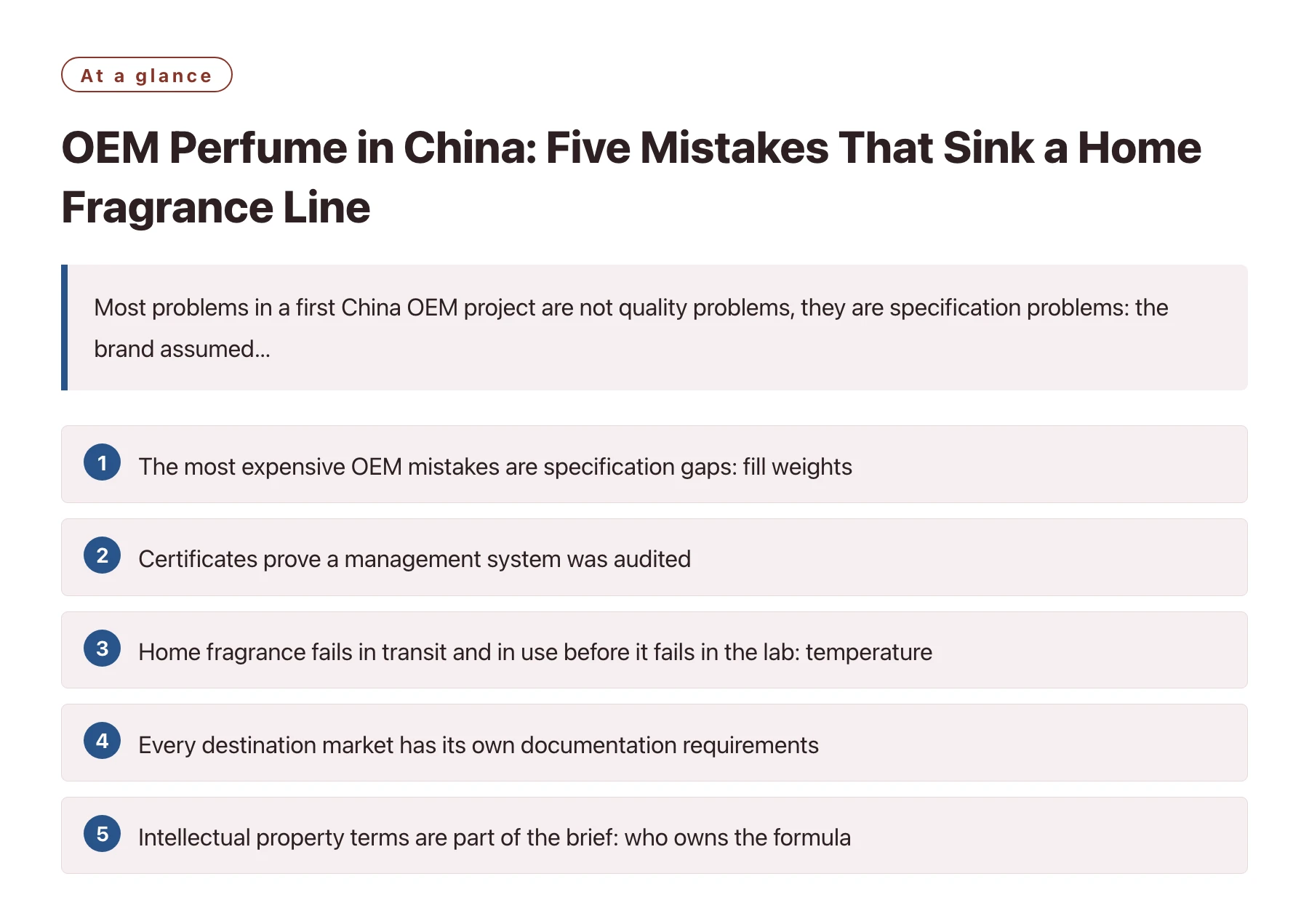
- The most expensive OEM mistakes are specification gaps: fill weights, thermal limits, wick sizes and packaging tolerances that were assumed instead of written down.
- Certificates prove a management system was audited; only batch records and a walk-through of one production run show what actually happens on the floor.
- Home fragrance fails in transit and in use before it fails in the lab: temperature, leakage and evaporation have to be tested at the packaging stage, not discovered by customers.
- Every destination market has its own documentation requirements, and checking them before the deposit is far cheaper than fixing them after shipment.
- Intellectual property terms are part of the brief: who owns the formula, the mould and the design files should be written down before sampling starts.
The pattern repeats across brands: a brief that says candle but not which wax, a quote accepted without a fill-weight tolerance, a first container that arrives with the wicks off-centre because nobody specified the centring check. Individually these look like small oversights; together they are the difference between a line that launches and a line that limps.
None of the five mistakes below is about catching a supplier being dishonest. They are about removing the ambiguity that lets small problems grow, and they are written from the buyer's side of the table for anyone sourcing OEM perfume or home fragrance in China.
Where China OEM projects usually drift
The bridge between a brand and a factory is the specification, and the specification is usually where the project starts to drift. A written brief pins down wax type, melt point, fragrance load, wick series, vessel dimensions, fill weight, labelling and packaging tolerances; an unwritten brief leaves each of those to someone's memory. Drift is not malice — it is the natural result of a project that runs on conversation instead of documents.
For a home fragrance line the stakes are higher than they look, because the product is judged in the customer's living room, not on the shelf. The evaluation therefore has to start with scope: find a perfume production partner in China whose in-house list — blending, filling, packing — matches what your product needs, because every subcontracted step adds a hand-off and a failure point.
Five moves that avoid the classic mistakes
- Write the specification, not the dreamPut wax type, melt point, fragrance load, wick series, vessel dimensions, fill weight and packaging tolerances into one document and send the identical brief to every candidate.
- Verify with documents and a walk-throughAsk for the certificate number and the issuing body, then ask to walk one batch record from raw material intake to release; a cosmetics GMP framework like ISO 22716 exists precisely to make that traceability routine [1].
- Test the journey before you test the marketHeat, cold and stacking pressure affect candles and diffusers in shipping; run a short transport simulation or ship a trial carton before committing to a full container.
- Confirm the destination-market paperwork earlySafety data sheets, ingredient lists and product notifications follow the market you sell into — cosmetics sold in Canada, for example, must meet specific safety and notification requirements there [2].
- Write down who owns whatState clearly whether the formula, the mould and the design files belong to you, and register what you can; the international systems administered by WIPO exist for exactly this kind of protection [3].
What to check before the deposit
The batch record, not the brochure
Certificates prove an audit happened; batch records prove a production run happened the way it should have. Ask to walk through one record for the product closest to yours — a supplier that works to GMP discipline every day will produce it without hesitation, and one that cannot is telling you something important.
Sample versus bulk, in writing
The approved sample and the bulk order have to be tied by a retained physical reference, held by both sides, with a date and a batch number. Home fragrance is sensitive to small changes in dose and vessel, so a reference standard is not a formality, it is the product.
Heat and cold are your real QA team
Candles travel in containers that can bake, and reed diffusers sit in cold warehouses; a maker that ships these products regularly has already learned which waxes, wicks and vessels survive. Ask about export experience explicitly, and ask whether the packaging was developed around those journeys.
Every mistake above is a negotiation you are having too late. Price, specification, ownership and documentation belong on one page before sampling, and both sides should sign it. If a candidate hesitates at that page, they have told you everything you need to know about the project.
When the process is right, the price conversation changes
Once the specification is fixed, quotes become comparable, and the comparison stops being about trust and starts being about numbers. The nasty surprise in this industry is rarely the quote; it is the follow-up — the charge for a change nobody documented, the delay caused by a step nobody named. A supplier that lays out its service scope openly, such as a maker that documents their OEM/ODM manufacturing services in detail, makes those follow-ups predictable, because the scope is the contract.
The same discipline applies whoever you work with. A supplier like Xuelei Fragrance that exports regularly will normally have the market documentation pack ready, but normal is not a document — verify the pack against the markets you actually sell into, the same way you verify everything else in this list.
Sources
- SGS: Cosmetics, Personal Care & Household Testing —— Testing, inspection and certification services for cosmetics and personal care, including microbiological, stability and safety testing aligned with cosmetics GMP.
- Health Canada: Cosmetic Safety —— Health Canada's cosmetics pages, covering cosmetic notification, the ingredient hotlist and safety requirements for cosmetics sold in Canada.
- WIPO — World Intellectual Property Organization —— The UN agency for intellectual property; resources on industrial design and patent protection relevant to product and packaging design.
Frequently asked questions
What is the most common mistake when sourcing OEM perfume in China?
Specification gaps. Products fail because fill weights, tolerances and testing steps were assumed rather than written down; the fix is a single written brief plus a retained reference sample.
How do I check that a Chinese factory's certifications are real?
Ask for the certificate number, the issuing body and the scope, then verify with the issuer directly. Treat the certificate as the start of a conversation, and confirm it with a batch-record walk-through.
Do candles and diffusers really need transport testing?
Yes. Wax can sweat and shift, glass can micro-crack, and reed oil can leak at temperature extremes; a short transport simulation before the container order is one of the cheapest tests you can run.
Who owns the formula if I brief a factory in China?
Whatever the contract says. If the brand commissions a formula through an OEM agreement, the ownership clause decides it; if the factory develops the scent under ODM, exclusivity is usually purchased separately. Write it down before sampling.
How many suppliers should I compare for a first order?
Three, with identical written briefs and identical questions. Compare the answers line by line, then verify claims with the walk-through; the price column is the last thing you look at.